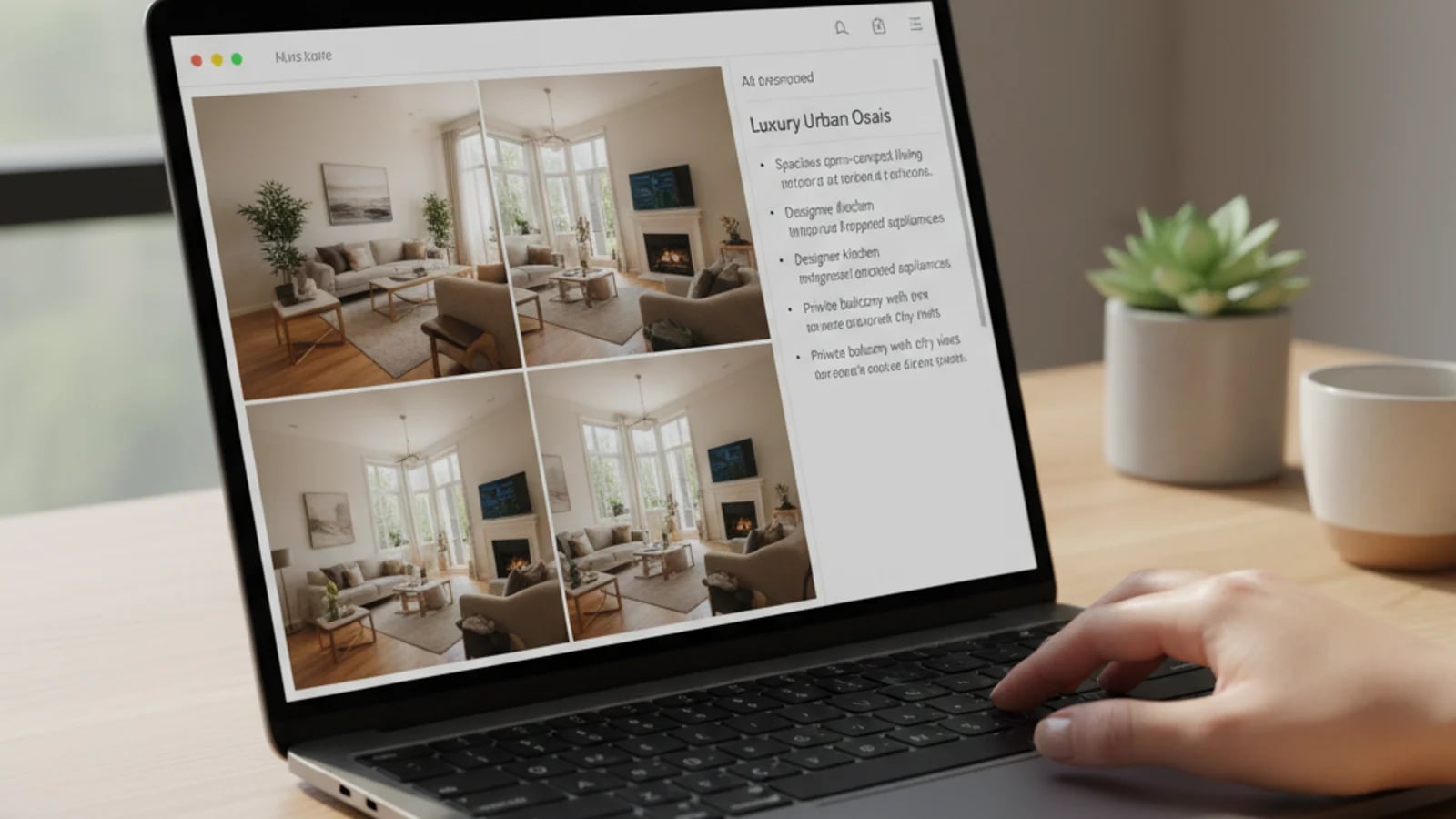
Writing listing descriptions is one of the highest-frequency, lowest-leverage tasks in a real estate agent's week. Every property needs one. Most agents write them in a hurry. And most read like every other listing on the portal — generic adjectives, recycled phrasing, no actual information that helps a buyer decide. AI changes this less by making the writing faster and more by making it possible to produce copy that is genuinely different from listing to listing. The catch is that AI does not know your jurisdiction's Fair Housing rules, your portal's character limits, or whether the staged sofa in the photo is actually there. This guide is about how to brief AI tools so the copy comes back useful, and how to integrate it with the rest of the listing — especially the photos.

Why AI changed the listing-copy workload — and where it still falls short
The clearest gain from AI for listing copy is not speed; it is variation. A human writer working through a queue of ten listings tends to reuse the same handful of openers and structures by listing five or six. An AI tool, given the right brief, will give each property its own angle without drifting into generic language — provided you tell it what makes the property worth writing about in the first place.
Where AI still falls short is judgement. It does not know that "exclusive neighbourhood" is a Fair Housing flag in the US; it does not know your portal cuts off at 1,000 characters; it does not know whether the kitchen photo it is describing has been digitally restaged. Those are the editorial decisions you still have to bring. The model produces draft material; you produce the listing.
Briefing the model: prompts that produce usable copy
The difference between a useless AI listing draft and a useful one is almost entirely in the brief. A prompt that says "write a listing for this 3-bedroom apartment" produces a generic paragraph. A prompt that gives the model a role, an audience, a tone, and the actual features that matter produces something you can edit instead of rewrite.
A strong brief usually includes: the property type and key specs (size, bedrooms, year built, lot if relevant); two or three details that genuinely set this property apart from comparable listings; the target buyer profile (first-time buyer, family upsizing, investor, downsizing); the channel (long-form portal, short-form social, email blast); and the tone you want. Models like GPT-4o and Claude produce noticeably better results when the brief reads more like a creative brief than a database row. The same logic applies whether you are drafting through ChatGPT, Claude, or a real-estate-specific tool — the model is only as good as the angle you give it.
Adapt the same property to each portal's rules
Different portals expect different things. Zillow and Realtor.com lean toward longer, narrative descriptions with room-by-room storytelling. Rightmove and Zoopla in the UK reward concise feature-led copy with key selling points high in the description. sahibinden and Emlakjet in Turkey expect technical specifications front-loaded — square metres, floor, orientation — before any narrative. idealista and Fotocasa in Spain sit somewhere between the two. Instagram and TikTok caption space is short enough that you are essentially writing a headline plus a single hook line.
Rather than write five separate drafts, write one strong long-form version and ask the model to compress and adapt it for each channel. Tell it the character limit and the convention — "give me a Rightmove-style version under 1,000 characters with key features in the first 200" — and you will get something close to publishable. Pair this with the portal-specific photo rules we cover in the UK portal photo guide and the US portal photo guide so the visual and written sides line up.
Match the words to the photos — and disclose what was edited
The fastest way a listing description loses trust is when it describes a property the photos do not show. If the gallery has a digitally virtually staged living room, the copy should support that frame without claiming furniture that does not exist on the day. If AI decluttering cleared a busy kitchen counter, the description should not promise "move-in-ready minimalism" the buyer will not actually walk into.
The simplest practice is to brief the AI on which photos are edited and what kind of edit was applied, then let it write around them accurately. Combine this with an explicit disclosure line in the description — most US MLS systems, and a growing share of European portals, now require disclosure on virtually staged frames. The MLS disclosure rules guide covers the specifics. The honest framing — "select images have been virtually staged to illustrate furnishing potential" — protects the listing and rarely costs the click.
Fair Housing and risky language — the AI does not know your jurisdiction
This is the area where AI-drafted copy fails most visibly. The US Fair Housing Act prohibits language that suggests preference for or against buyers based on protected classes including race, religion, family status, and disability. Phrases that read as neutral to an AI model — "perfect for a young professional family", "quiet exclusive community", "walking distance to St Mark's" — can carry real legal risk in a US listing. The NAR Fair Housing Act overview is the practical reference.
Outside the US, the rules differ but the principle is similar: UK estate agents work under the Equality Act 2010; EU jurisdictions each have their own framing. The shortest defensive read is to scan AI-generated copy for any line that describes who the property is right for, and rewrite it to describe what the property has. "Three bedrooms and a finished basement" is safe; "perfect for a growing family" is not.
From copy to video: voiceover and AI presenter pipeline
Once you have a strong written description, it is worth getting more than one use out of it. The same copy that goes on the portal can be the script for a short property tour video. AI voiceovers turn a written description into a polished narration in seconds, and AI presenter tools put a digital host in front of the camera reading it without booking a videographer.
For social, the short-form reels workflow takes the same script down to a 20- to 30-second cut. The advantage of starting from a single well-edited description is consistency — the buyer encounters the same property positioning across the portal page, the email follow-up, the Instagram reel, and the open-house presentation. The same end-to-end approach we cover in our AI presenters for property tours guide pairs well with this.
Editing the AI draft: the five-minute pass that matters
A useful working rhythm is to treat the AI draft as a 70-percent version. The remaining 30 percent — the part that turns a competent description into a listing that actually sounds like you — is a short editorial pass that takes about five minutes per property. Cut clichés the model defaults to ("nestled", "boasts", "stunning", "must-see"). Replace generic adjectives with concrete details. Check that any number the model produced (square footage, build year, council tax band, HOA fees) matches your source. And add the one or two genuinely property-specific lines that the model could not have known unless you had told it — the local bakery on the corner, the bus that goes to the city centre in twelve minutes, the original tilework in the entrance.
That five-minute pass is where AI-drafted copy stops sounding AI-drafted. Skipping it is the single most common reason agents say AI listing tools "do not work" — the issue is rarely the model, it is the absence of editing.
Sources and further reading
Frequently asked questions
Does Google penalize AI-generated listing descriptions?+
Google has been explicit that the issue is not whether content was generated with AI but whether it is useful and original. Listing descriptions that add property-specific detail — neighbourhood context, unusual features, accurate technical specs — perform fine. Listings that read like generic AI filler with no specifics tend to rank poorly regardless of who wrote them.
Which AI tool is best for writing real estate descriptions?+
General-purpose models like GPT-4o and Claude work well when you give them a strong brief and edit the draft. Real-estate-specific tools save the briefing step but tend to produce more template-feeling output. The choice depends on volume: at one or two listings a week, a general tool plus a five-minute edit is usually best; at higher volume, a specialised tool that ingests your MLS data is worth the subscription.
How should I disclose virtual staging in the description?+
A single clear line is enough — for example, "Select images have been virtually staged to illustrate furnishing potential." Place it at the end of the description or in a dedicated disclosure section. Most US MLS systems now require this, and a growing share of European portals expect it as best practice even where it is not strictly mandated.
Can AI write my listing headline as well?+
Yes, and headlines are actually one of the higher-leverage uses of AI for listings. Ask the model for five to ten headline options against the same brief, then pick the one that best matches the photo. The headline should usually lead with location plus one concrete advantage, not a generic superlative.
What is the biggest mistake agents make with AI listing descriptions?+
Publishing the first draft. The model produces a competent generic version of any listing you describe to it; what makes a description actually convert is the property-specific edit that adds the details only you know. Without that editorial pass, AI-drafted listings tend to read interchangeably with every other listing on the portal, which defeats the point.
Topics covered in this guide
AI listing descriptions, ChatGPT for real estate, real estate copywriting AI, AI for real estate agents, how to write listing descriptions.