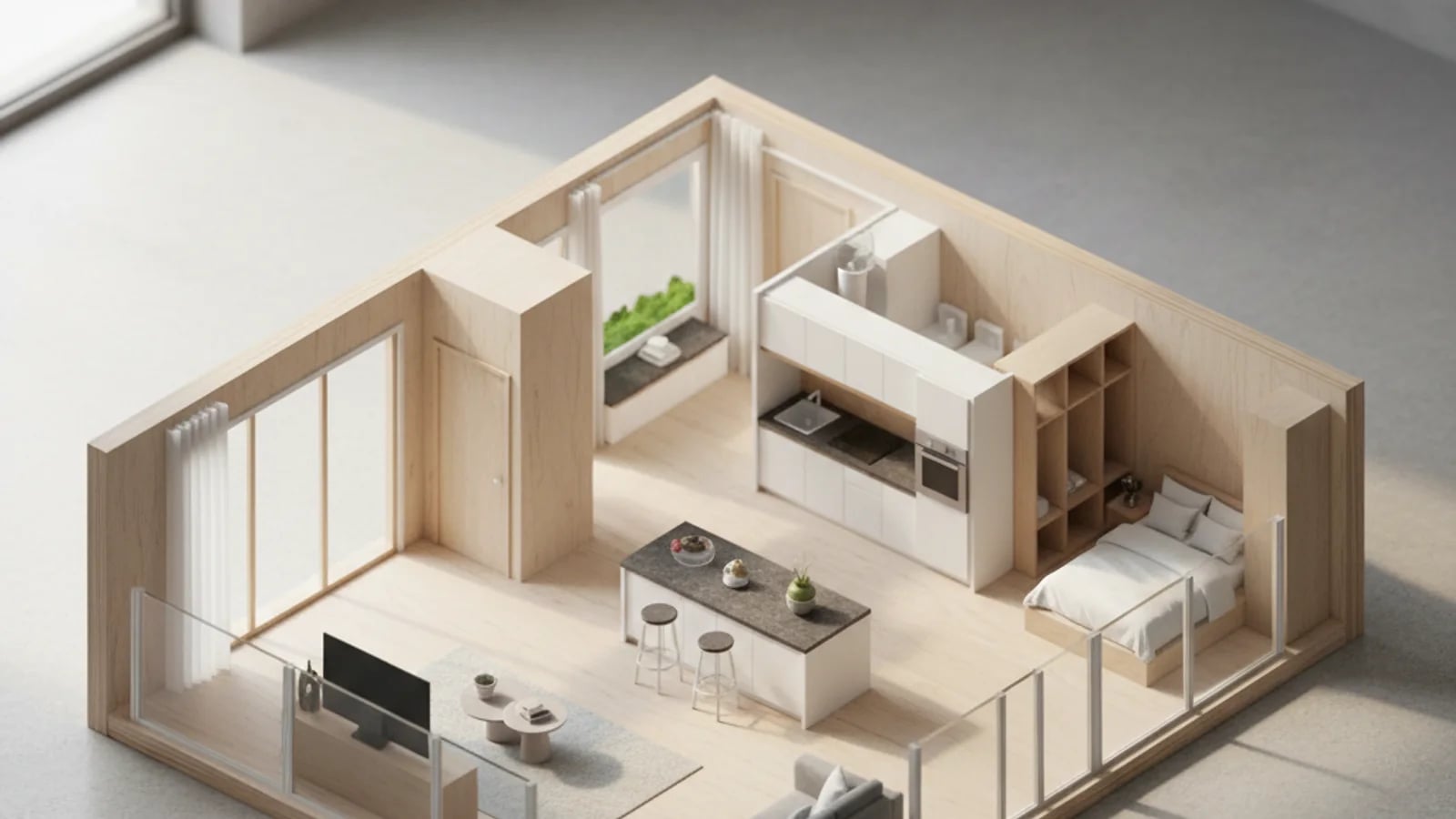
Traditional two-dimensional floor plans have been a listing staple for decades, but buyers rarely build a confident sense of a property's flow from lines on a page alone. The newer generation of AI floor plan tools changes the input side of that equation. Instead of needing an on-site laser measurement or a Matterport rig, they read the photos you already have in the listing folder and reconstruct an approximate three-dimensional model of the space. This guide walks through how that reconstruction actually works, where the output is reliable, how to prepare source images so the result looks professional rather than warped, and which disclosure rules apply when you publish an AI-generated layout on the MLS or a major portal.
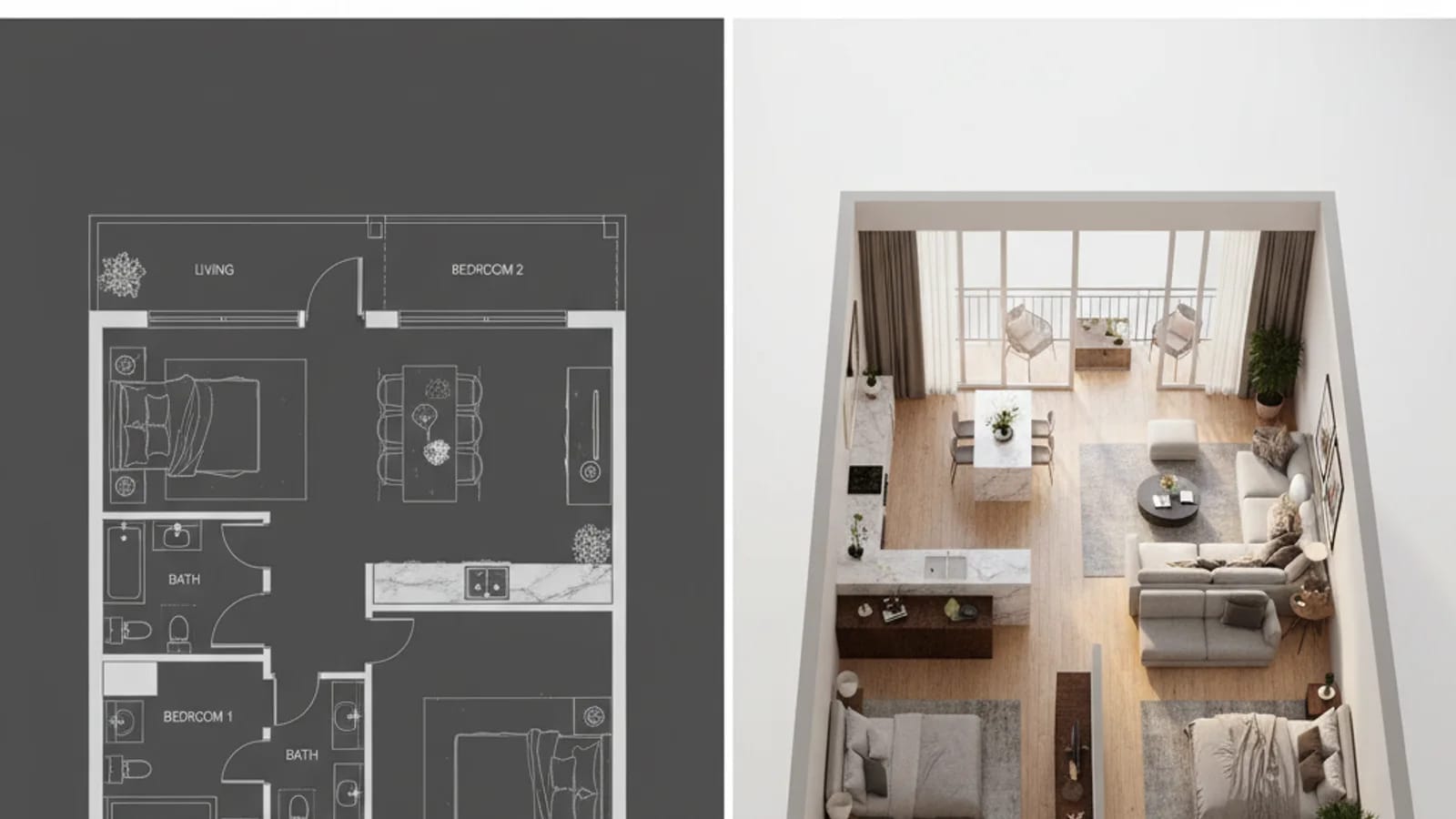
How AI builds a 3D floor plan from photos
AI floor plan generators combine computer vision and depth estimation models to find the structural cues inside ordinary listing photos: corners, ceiling lines, door frames, and the shapes where walls meet floors. From those cues, the model infers room geometry, approximate dimensions, and how each room connects to the next.
Most modern systems accept anywhere from one to a dozen photos per room. With more coverage the model has more reference points to triangulate against, which produces a more reliable layout. With only one or two frames per room, the output is still useful for showing relative size and adjacency, but the absolute dimensions become looser estimates rather than measurements.
The practical effect is that work which once took an on-site survey or hours of manual drafting can now be turned around in minutes from the same image set you already use for the listing photos. For agents who batch fifteen or twenty listings a month, that turnaround changes what is economically worth producing — a topic we cover in how real estate teams scale listing visual production.
Why floor plans still move the needle on listing engagement
The case for floor plans is not new. Rightmove's own consumer research has repeatedly shown that floor plans are among the most-requested missing pieces on a listing, and the NAR Profile of Home Buyers and Sellers has tracked floor plans as one of the most useful features on a property website for years. Buyers want to mentally rehearse the space before they spend a Saturday driving to it.
An AI-generated 3D model takes that rehearsal one step further. Instead of asking the buyer to read a flat plan and translate it into a mental walkthrough, the model already shows the spatial relationship: how the kitchen sight-line opens into the living area, how the master bedroom sits relative to the rest of the upper floor, whether the dining space can realistically host the buyer's existing furniture. That is the gap a two-dimensional plan does not always close.
The detailed breakdown of why floor plans correlate with higher engagement is covered in why listings with floor plans generate better leads. 3D variants amplify the same effect, but only when the source data and the disclosure are handled properly.
Preparing source photos so the model has something to work with
The quality of an AI 3D plan is bounded by the quality of the photos it reads. Wide-angle shots that show all four corners of a room, neutral exposure, and clear sight-lines to the floor and ceiling give the model far more to triangulate against than dark, tightly cropped frames.
A few practical preparation steps:
- Use the widest lens you have that does not introduce heavy barrel distortion — 16mm to 24mm full-frame equivalent is the usable range.
- Shoot at chest height, not from the doorway corner. Centered framing helps the model detect the floor plane.
- Capture at least one frame per wall in larger rooms, not just one hero shot.
- Remove obvious obstructions when you can. Suitcases, laundry baskets, and pet beds confuse depth estimation.
Cleaning up the inputs before reconstruction also pays off. Running the photos through ai photo enhancement to even out exposure makes corners and edges more readable to the model. For cluttered rooms, furniture removal simplifies the geometry so the algorithm spends its budget on walls instead of guessing around piles of objects. The same principle applies to occupied homes — see how to prepare an occupied home for listing photos without moving out for the wider workflow.
Where AI reconstructions are reliable, and where they are not
It is worth being precise about what an AI 3D plan is. It is a probabilistic reconstruction of geometry from images. It is good at relative proportions, adjacencies, and giving buyers an intuitive feel for the home. It is not a substitute for a surveyor's measurement, an architectural drawing, or a tape measure walked across the floor.
In practice, expect the model to be confident on:
- Room shape and approximate footprint.
- Adjacencies — which room opens into which.
- Door, window, and opening positions.
- Ceiling height in rooms where the ceiling is visible in multiple frames.
And expect it to soften on:
- Exact square footage versus the title deed.
- Tight corners hidden behind furniture.
- Rooms shot with only one image and no overlap.
- Outdoor structures and irregular roof shapes.
This is the same general rule the International Property Measurement Standards Coalition has long applied to building area reporting: published measurements should match a defined standard, and any approximation should be labelled as such. Treating an AI plan as a marketing visualization rather than a measurement document keeps the listing on the right side of that line.
Pairing 3D plans with virtual staging for empty properties
An empty property is the hardest sell in any market. Buyers see square footage as a question rather than an answer, and an unfurnished 3D plan does not always close that gap on its own. Combining the reconstructed layout with virtual staging bridges the missing context — buyers see both the shape of the home and a realistic interpretation of how it lives.
The same logic applies to off-plan and new construction listings, where the only assets you have are renderings and a layout. Layering an AI-generated 3D plan over staged renders helps buyers stitch together a single, coherent picture of the unit. The general staging case is laid out in the complete guide to ai virtual staging for real estate.
Disclosure, MLS rules, and how to label AI-generated layouts
AI-generated visuals sit inside the same disclosure framework as virtual staging and AI photo edits. The NAR Code of Ethics Article 12 requires honest representation in advertising, and NAR has been consistent in its guidance that AI-modified listing photos must not mislead a reasonable consumer about the actual condition or features of the property. The Federal Trade Commission's endorsement and advertising guides reach the same conclusion for the US consumer-protection layer. In the UK and most international markets, RICS guidance and the International Property Measurement Standards play the equivalent role.
Practical rules of thumb that keep an AI 3D plan on safe ground:
- Label every published 3D plan as a representation, not a measurement. Wording such as "Illustrative — dimensions are approximate" or "For visualization purposes only" placed directly on the asset is the cleanest approach.
- Do not invent rooms, openings, or square footage that the source photos do not support.
- If the listing carries an official measurement (RICS report, surveyor's plan, builder's drawing), state that the AI plan is supplementary and that the official document governs.
- If the 3D plan is paired with virtual staging, disclose the staging separately as well.
The full disclosure pattern for staging is covered in virtual staging MLS disclosure rules; the principles transfer directly to AI floor plans.
Sources and further reading
- NAR — Highlights from the Profile of Home Buyers and Sellers
- NAR — Code of Ethics, Article 12 (truthful advertising)
- International Property Measurement Standards Coalition (IPMSC)
- RICS — Property Measurement professional standard
- Rightmove Press Centre — consumer behaviour releases
- Zillow Research
- FTC — Endorsement Guides FAQ (advertising representations)
- ISO 9836 — Performance standards in building: area and space measurement
Frequently asked questions
Do I need a professional camera to generate an AI 3D floor plan from photos?+
Not strictly. Sharp, well-lit smartphone frames are usually enough if every wall of every room is covered. A wide-angle prime lens on a mirrorless camera produces noticeably better geometry because barrel distortion is lower and corners are easier for the model to identify.
Can I publish the dimensions from an AI 3D plan as official measurements?+
No. AI reconstructions are approximations derived from images and should be labelled as such. If your jurisdiction requires a measurement standard — RICS or IPMS for the UK and international, ANSI Z765 for the US — that document remains the authoritative source and the AI plan is supplementary.
How long does it take to produce a 3D floor plan from listing photos?+
Most modern AI tools process a single property in minutes once the photos are uploaded. The bottleneck is usually the quality of the source images, not compute time. Workflows that combine enhancement, decluttering, and reconstruction in one platform are typically done well inside a single working session.
Can I add virtual furniture to an AI-generated 3D plan?+
Yes, and this is where the technology becomes most useful for empty properties. Pairing the reconstructed layout with virtual staging gives buyers both the shape of the home and a sense of how it lives. Both modifications should be disclosed in the listing.
What goes wrong most often with AI floor plans, and how do I avoid it?+
The two most common failure modes are missing walls in rooms that were shot from only one angle, and warped geometry in rooms with mirrors, glass partitions, or heavy clutter. The fix in both cases is on the input side: cover every wall with at least one frame and remove or simplify reflective and cluttered elements before reconstruction.
Topics covered in this guide
AI 3D floor plans, 3D floor plan from photos, AI floor plan generator, real estate floor plans, AI listing visuals, property layout reconstruction, virtual staging floor plan, MLS disclosure AI.