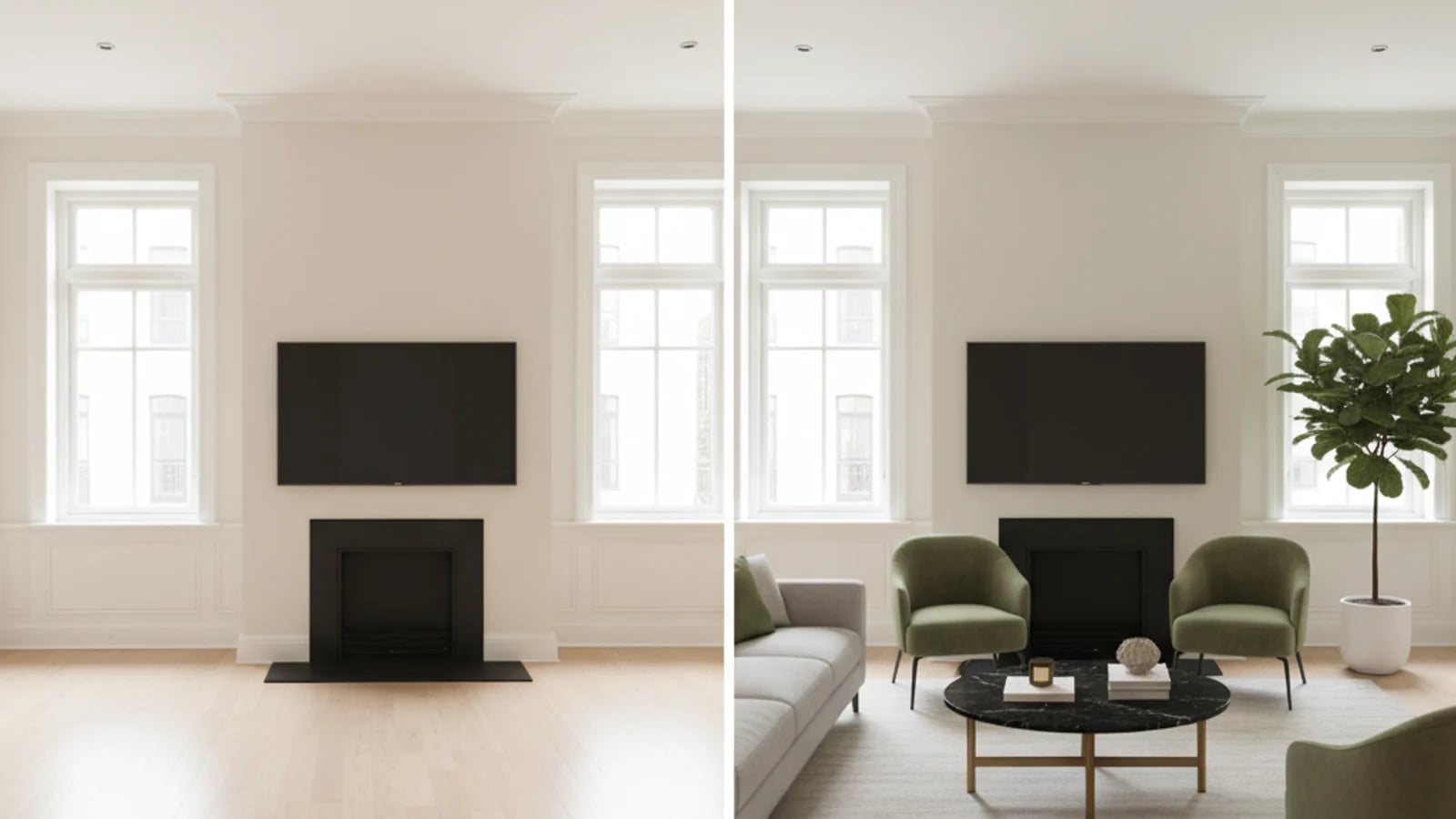
Virtual staging before-and-after images are persuasive for one reason: they compress the buyer's imagination problem. Empty rooms often photograph honestly but weakly. Buyers can see the shell, but they cannot always see the use. A strong before-and-after comparison solves that gap by showing the room as it is and the room as it could work.

The best before-and-afters solve a real comprehension problem
Virtual staging is strongest when the original image has a genuine communication problem: the room is empty and scale is hard to judge, the layout is awkward without furniture cues, the buyer cannot tell how the space should function, or the listing feels colder than the property deserves.
That is why living rooms, primary bedrooms, and open-plan spaces usually produce the most useful before-and-after results. These are the rooms where furniture placement helps buyers interpret size, circulation, and emotional tone quickly.
NAR's Profile of Home Staging reinforces a simple truth: staging helps when it makes it easier for buyers to visualize the property as a future home. Virtual staging should be judged by that same standard.
Good staging improves readability, not fantasy
The best after image usually does not look radically different from the before. It still looks like the same room, with the same proportions, same light direction, and same architectural constraints. What changes is readability. The room becomes easier to interpret and easier to remember.
That usually comes from:
- believable furniture scale
- cleaner focal points
- stronger room purpose
- restrained styling
The common mistake is overcorrecting. If the room suddenly looks much larger, more luxurious, or more renovated than it really is, the before-and-after stops working as marketing and starts creating doubt. Virtual staging should reduce ambiguity, not disguise reality.
Before-and-after works best when the original image is still shown
One reason before-and-after assets are powerful is that they can preserve trust while still helping the buyer imagine the room. Showing both the original and the staged version keeps the comparison anchored in reality. It signals confidence instead of concealment.
That is especially important in markets where altered images are expected to be disclosed clearly. The FTC's Advertising and Marketing Basics is a useful general reminder that marketing should not be deceptive. In practical listing terms, staged images should help explain the property, not misrepresent it.
The safest workflow is simple: keep the original image, create a believable staged version, label or disclose altered images where appropriate, and use the staged image to support the listing — not replace the underlying truth.
The after image should match the property's market position
Virtual staging gets stronger when the style fits the likely buyer profile. A small city apartment, a suburban family home, and a premium new-build should not all receive the same aesthetic treatment. The job of staging is not to express the editor's taste. It is to make the property legible to the market it is trying to reach.
Use staging to answer questions like: Is this home better sold as bright and minimal or warm and family-oriented? Does the room need softness, structure, or function? What kind of buyer needs help understanding this space? When those answers are clear, staging becomes a positioning tool rather than a generic visual effect.
Before-and-after content can work beyond the listing itself
These comparisons also perform well as educational and commercial assets because they are easy to understand at a glance. A buyer sees the difference immediately. A seller sees the marketing logic immediately. That makes before-and-after content reusable in listing presentations, blog posts, social media, and nurture campaigns.
From a search perspective, image clarity matters there too. Google's image SEO best practices are a good reminder that strong visuals work best when they are supported by relevant text, clear context, and a high-quality landing page. The image plus explanation is the asset, not the image alone.
What actually improves performance?
In practice, virtual staging before-and-after content improves listing performance when it does three things well: makes the room easier to understand, keeps the result believable, and supports the broader listing story.
That is why the strongest staged comparisons are disciplined, not flashy. They help buyers imagine living in the home without forcing them to suspend disbelief. The point of before-and-after is not to prove that software can transform a room. It is to prove that the listing can communicate potential more clearly. When it does that, performance tends to improve for the right reason: the buyer understands the opportunity faster.
Sources and further reading
Frequently asked questions
Which rooms benefit most from virtual staging before-and-after?+
Living rooms, primary bedrooms, and open-plan spaces. These are the rooms where furniture placement most helps buyers interpret size, circulation, and how the space should function.
Should the original unstaged image still be shown alongside the staged version?+
Yes. Showing both versions keeps the comparison anchored in reality, signals confidence, and reduces the risk of misrepresentation — especially in markets with disclosure expectations.
Can before-and-after staging content be used outside the listing itself?+
Yes. These comparisons work well in listing presentations, blog posts, social media, and nurture campaigns because the difference is immediately legible to both buyers and sellers.
Topics covered in this guide
virtual staging before and after, before and after virtual staging, virtual staging results, virtual staging for listings, does virtual staging improve listing performance.